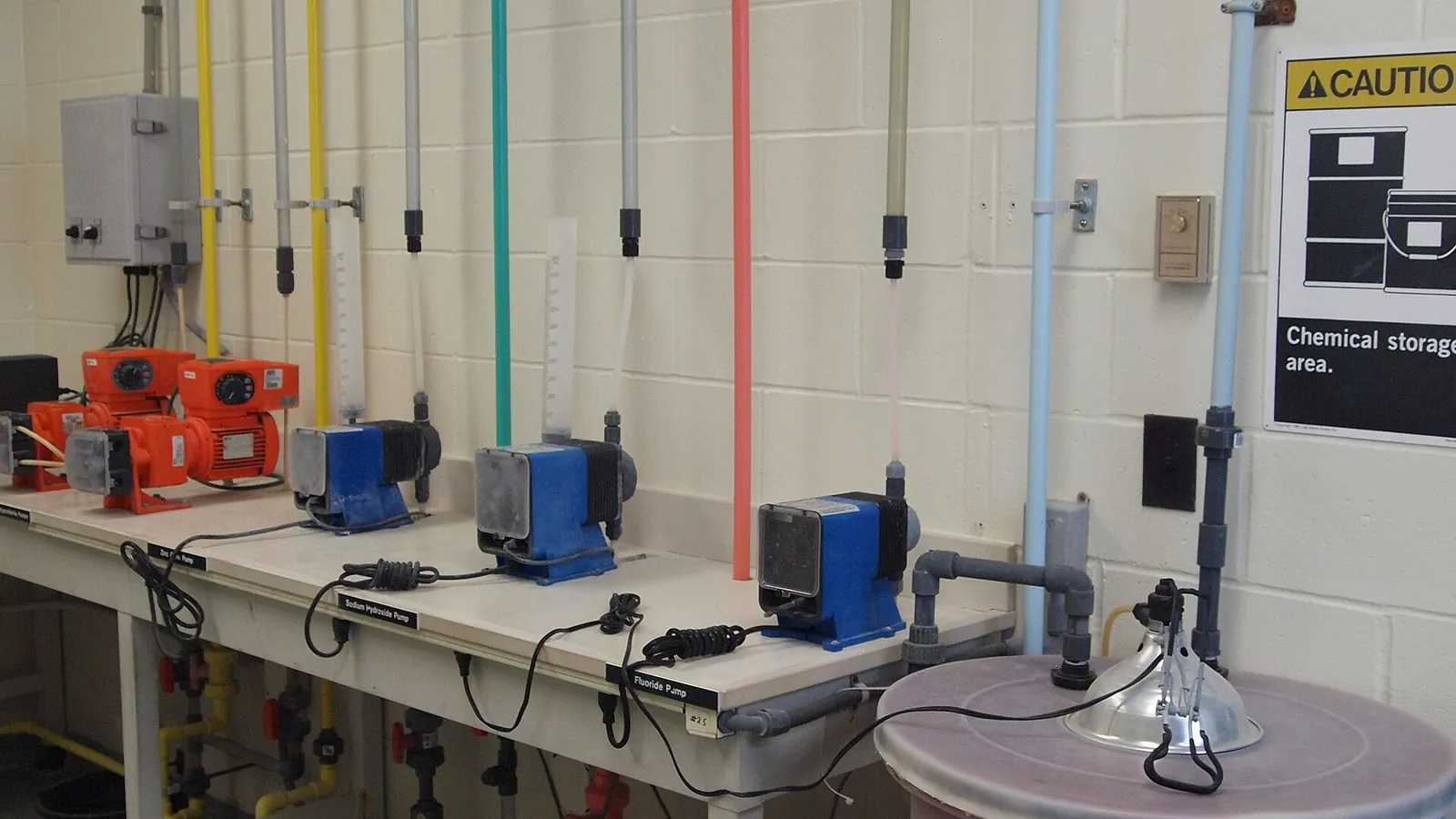
Why a Peristaltic Pump Is Well Suited to Chemical Dosing
Chemical dosing systems share a common set of problems: the media is aggressive, the required dose is small and continuous, and any leak or overfeed has cost, safety or compliance consequences. Peristaltic pumps have become a standard answer for this duty across water treatment plants, industrial process lines and laboratories, and the reasons are structural rather than cosmetic:
- Seal-free, leak-free fluid path. The liquid only ever touches the inside of the tube. There are no mechanical seals, no gland packings and no valves in the wetted path, which means there is no seal to wear out, no drips at the pump head, and no fugitive vapor escaping past a failing gland. For media like hypochlorite or caustic, that containment alone justifies the pump class.
- Self-priming and dry-run tolerant. Most dosing models pull their prime from a drum or day tank sitting below the pump, with typical suction lifts of 2–3 m on standard units. They can also run dry for short periods without damage — the tube is the sacrificial component, not the motor or the head.
- Corrosion resistance by construction. Because the wetted surface is a flexible tube, chemical resistance is decided by the tube material rather than the pump body. Pair a PP or PVDF housing with PTFE-lined tubing and the pump handles most acids, alkalis and solvents found on a dosing skid.
- Metering accuracy. Stepper-driven peristaltic dosing pumps commonly deliver flow repeatability around ±1%, which is adequate for pH correction, flocculant dosing and disinfectant metering, provided the system back-pressure stays stable and the tube is calibrated.
- Handles slurries, viscous and shear-sensitive media. Flocculant solutions, lime slurries and polymer emulsions pass through a wide-bore tube without clogging valves, and the gentle rolling action applies low shear to the fluid.
- Low maintenance complexity. There is one consumable — the tube — and replacing it takes minutes on most heads without special tooling. No valve lapping, no diaphragm replacement, no seal kits.
None of this makes a peristaltic pump the right choice for every dosing duty. Very high pressures, very high flows and some solvents remain better served by other pump types. But for the typical range of dosing applications — a few millilitres per hour up to a few hundred litres per hour at pressures up to roughly 1 bar — a peristaltic pump is often the most predictable option available.
Chemical Compatibility: Matching the Tube to the Medium
The single most important material decision in a peristaltic dosing system is the tubing, because the tube is the entire wetted path. The table below gives general guidance for common dosing media; always confirm your specific concentration, temperature and pressure against the manufacturer's full compatibility chart before committing.
| Medium | Typical Concentration | Recommended Tubing | Notes |
|---|---|---|---|
| Sulfuric acid | Up to ~50% | PTFE-lined | Silicone degrades in strong acids; PTFE-lined tube resists attack |
| Sodium hydroxide (caustic) | Up to ~50% | PTFE-lined | Also check housing and fittings for alkali resistance |
| Sodium hypochlorite (bleach) | 5–15% | Norprene / EPDM or PTFE-lined | Silicone hardens and loses elasticity with prolonged oxidizer contact |
| Hydrochloric acid | Dilute to ~30% | PTFE-lined | Confirm concentration and temperature before selection |
| Ferric chloride / alum (coagulants) | 10–40% | PTFE-lined | Acidic; some installations run silicone at low concentration with short service intervals |
| Polyacrylamide solutions (flocculants) | 0.1–0.5% | Silicone | Low aggression; low-shear pumping preserves polymer structure |
| Water / mild aqueous media | — | Silicone | General-purpose choice with good elasticity and low cost |
Three tube families cover most dosing work. Silicone is the general-purpose option: elastic, food-contact compatible in many grades, and inexpensive, but it is attacked by strong acids, strong oxidizers and many solvents. PTFE-lined tubing (a PTFE inner liner with an elastomer compression layer) brings the chemical resistance of fluoropolymer to the fluid path while keeping the flexibility the pump needs — this is the default for aggressive acid, alkali and solvent dosing. Norprene or EPDM tubing suits oxidizers such as hypochlorite and ozone service where silicone would harden prematurely. A quick rule of thumb: if the medium would attack a natural rubber glove, treat silicone with suspicion and check the compatibility chart before relying on it.
Selection in Five Steps
Work through these five decisions in order, and most dosing pump selections resolve themselves:
- Define the required flow rate. Convert your dose (mg/L, ppm or g per hour) into a volume flow in ml/min or L/h, including any turndown you need. Peristaltic dosing pumps typically cover from a fraction of a millilitre per minute up to tens or hundreds of litres per hour. Then choose a tube size whose mid-speed range (roughly 100–300 rpm) hits your target — sizing to the middle of the speed range keeps accuracy higher and tube wear lower.
- Confirm the system pressure. Add the static discharge head, the injection-point pressure and pipe friction. Standard peristaltic dosing pumps handle around 1 bar of back-pressure; reinforced tubing and high-pressure heads extend this to roughly 6 bar on specialist models. Pressure is worth stating clearly at the enquiry stage, because it is the main factor that shortens tube life.
- Select wetted materials. Choose the tube material from the compatibility table first, then confirm the pump head housing (PP, PVDF or aluminum), rollers and fittings survive the same chemistry. For aggressive media, a PVDF head with PTFE-lined tubing is the conservative combination.
- Choose the control mode. Manual speed control covers simple fixed-dose jobs. For process integration, look for analog 4–20 mA input, RS485 communication, or pulse input from a flowmeter or controller for proportional dosing. Stepper drives give the ±1% repeatability that pH and disinfectant loops rely on; simpler DC-motor units trade some accuracy for lower cost.
- Budget for the whole life, not just the purchase. On a dosing pump, tube replacement is the recurring cost. Compare tube price, expected service life at your speed and pressure, spare availability and lead time, not just the initial unit price. A slightly more expensive tube that lasts several times longer is usually the cheaper choice.
Typical Chemical Dosing Applications
Peristaltic dosing pumps appear across a wide range of industries. The most common duties include:
- Water and wastewater treatment — pH control. Acid or caustic is dosed into an influent or process stream in response to a pH analyzer. Flows are small, adjustments are frequent, and the seal-free design keeps aggressive chemicals contained. A stepper-driven pump with 4–20 mA or RS485 input is the standard fit.
- Coagulant and flocculant dosing. Alum, ferric chloride and polyacrylamide solutions are viscous and shear-sensitive. Wide-bore peristaltic tubing passes them without clogging, and gentle pumping preserves the polymer chains that flocculation depends on.
- Disinfectant metering. Sodium hypochlorite, chlorine dioxide precursors and peracetic acid are oxidizing media that demand the right tube (Norprene, EPDM or PTFE-lined) and vented fittings where gas evolution is possible. Metering accuracy matters because under- and over-dosing both have compliance and safety implications.
- Antiscalant and corrosion inhibitor dosing. Cooling towers, boilers and reverse-osmosis plants dose small continuous quantities of inhibitor. The low, steady flows are well within peristaltic pump range, and tube replacement is a quick routine task.
- Laboratory reagent dispensing. Benchtop analyzers, sample preparation lines and multi-channel filling use peristaltic pumps for reproducible reagent volumes, often with several channels running different fluids from one drive.
Maintenance Essentials
A peristaltic dosing pump has effectively one wear part, but that part needs to be managed actively:
- Treat the tube as a consumable with a schedule. Inspect weekly where practical. Replace the tube at the first sign of cracking, permanent flattening, discoloration, swelling or leakage, or when flow drops by roughly 10% from a calibrated baseline.
- Check the occlusion setting. Over-tight occlusion crushes the tube and dramatically shortens its life; under-tight occlusion allows back-flow and hurts accuracy. Set it per the manufacturer's procedure for your tube size.
- Flush before shutdown. For crystallizing or gassing media such as hypochlorite or caustic, run a compatible flush fluid through the line before extended idle periods so residue does not set inside the tube.
- Keep rollers and track clean. Dried chemical residue on the head accelerates roller and tube wear. A damp cloth wipe on the same schedule as tube inspection is usually enough.
- Log replacement dates. A simple log of tube changes per pump quickly reveals recurring early failures, which usually point to a wrong tube grade, excessive pressure or an occlusion problem rather than bad luck.
FAQ
Can a peristaltic pump dose sodium hypochlorite?
Yes, with the right tubing. Norprene, EPDM or PTFE-lined tubes handle bleach service far better than silicone, which hardens and loses elasticity over time in oxidizer contact. Where hypochlorite off-gasses in the line, use vented fittings and keep the system pressure steady.
What accuracy can I expect from a peristaltic dosing pump?
Stepper-driven dosing pumps commonly achieve flow repeatability of about ±1%. Absolute accuracy also depends on tube calibration, speed stability, temperature and system back-pressure — a fixed, stable back-pressure is the single easiest way to hold accuracy in the field.
How often does the tubing need to be replaced?
Manufacturers quote tube service life in hundreds to a few thousand hours depending on the media, speed, pressure and tube grade. Replace the tube at the first visible cracking or when flow drops around 10% — operating a worn tube to failure risks a leak in the middle of a dosing run.
Can the pump run dry?
Most peristaltic dosing pumps can run dry for short periods because the tube is the wear component — but dry running is not indefinite. Extended dry running generates heat and accelerates tube wear, so check the manufacturer's dry-run rating for your model.
What back-pressure can a peristaltic dosing pump handle?
Standard dosing models are typically rated to about 1 bar. With reinforced tubing and high-pressure pump heads, specialist peristaltic pumps extend to roughly 6 bar. Always state the worst-case injection-point pressure when sizing, since pressure directly affects tube life.
Conclusion
A peristaltic pump is a strong default candidate for chemical dosing whenever the flow is small-to-medium, the pressure is modest and the chemistry is aggressive. Its advantages — seal-free containment, self-priming operation, corrosion resistance carried by the tube, and ±1% class repeatability on stepper drives — address the failures that dosing systems actually experience. Select the tube from a compatibility chart before anything else, size the flow to the mid-speed range, state your pressure honestly, and treat tube replacement as routine maintenance rather than a fault.
Related guides: Peristaltic vs Diaphragm Pumps: Which Is Right for Your Process? · How Long Does Pump Tubing Last? · Peristaltic Pump Head Guide: Types, Specs & Selection
NEXT STEP
Need a Dosing Pump Recommendation?
Send us your chemical, concentration, required flow and injection pressure — we will confirm tube compatibility and respond within 24 hours with pricing and lead time.