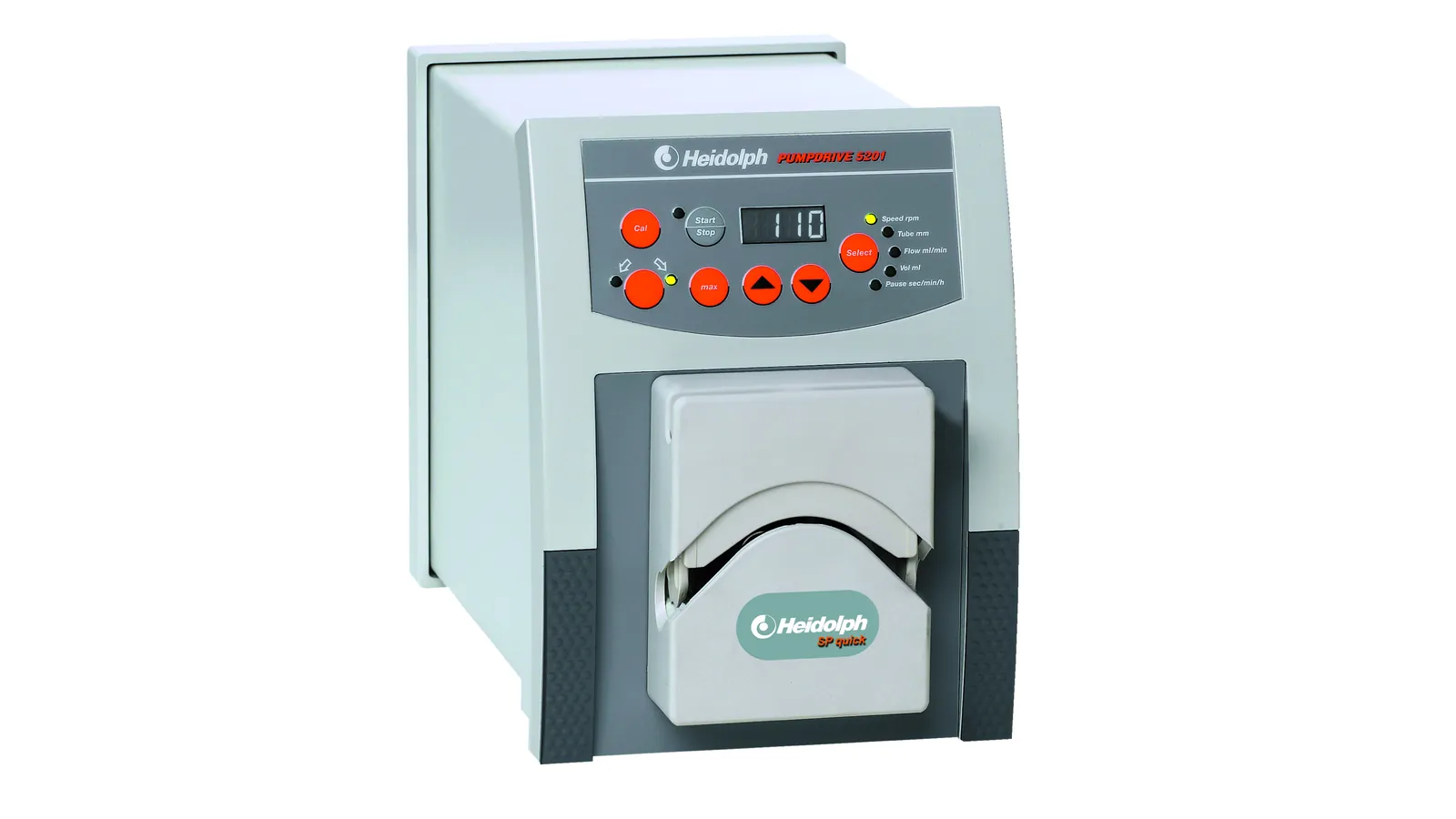
What Is a Peristaltic Pump Head?
A peristaltic pump head (also called a pumphead, pump cartridge or pump module) is the fluid-handling assembly that contains the rollers, rotor, tube track and housing. It is the component that physically compresses the tubing against a curved track, pushing fluid forward in a wave-like (peristaltic) motion. The pump head is mounted on a drive — either a stepper motor, brushless DC motor, or AC motor — and it is the part you swap when tube size or flow requirements change.
Unlike the pump drive (motor + controller + display), the pump head is a purely mechanical module. That separation is one of the biggest advantages of peristaltic pumps: you can run several different heads on one drive, change flow ranges by changing the head, and replace a worn head without touching the electronics.
How a Peristaltic Pump Head Works
The working principle is simple but elegant:
- Roller compression. One or more rollers rotate and squeeze the flexible tube flat against the curved track.
- Fluid displacement. The squeezed section pushes fluid forward as the roller advances.
- Elastic recovery. After the roller passes, the tube's elasticity snaps it back to round, creating a vacuum that draws in the next slug of liquid.
- Repeat. The continuous cycle produces a steady, pulsatile flow proportional to rotor speed.
Because the fluid only ever touches the inside of the tube — never the rollers, housing or motor — a peristaltic pump head delivers three fundamental advantages: no cross-contamination (the fluid path is single-use), self-priming (dry-run capable for most designs), and low maintenance (the only wear part is the tube itself).
Main Types of Peristaltic Pump Heads
Pump heads are classified by their roller configuration and tube mounting style. The three most common series in industrial and laboratory use are:
YZ Series (Standard Multi-Channel Heads)
The YZ series is the workhorse of the peristaltic pump world. It uses a channel design with 3 rollers per channel and accepts standard tubing sizes (13#–18# for YZ15, up to 25# for YZ35). YZ heads are available in 1, 2 and 4-channel configurations, letting one drive pump several fluids simultaneously — ideal for filling lines, multi-channel media dispensing and parallel dosing.
- YZ15: fits 13#, 14#, 19#, 16#, 25#, 17#, 18# tubing; flow range roughly 0.014–4560 ml/min depending on drive speed.
- YZ35: fits larger tubing (up to 35# class); higher flow for industrial transfer, up to 12,000 ml/min.
LP Series (Compact/Low-Profile Heads)
The LP series (e.g. LP15-6) is a low-profile, lightweight head designed for OEM integration and space-constrained equipment. It keeps the same tube compatibility as YZ15 but in a smaller footprint, often with a fixed occlusion setting that simplifies installation. LP heads are popular in medical devices, benchtop analyzers and compact filling equipment.
Multi-Channel & Special Heads
Beyond YZ and LP, there are dedicated multi-channel heads (6, 8 or even 12 channels) for high-throughput dosing, sanitary/hygienic heads with smooth-flow internals for food and pharma, and high-pressure heads rated for 6 bar or more using reinforced composite tubing.
Key Specifications Explained
When comparing pump heads, these are the specifications that actually matter:
| Spec | What It Means | Typical Values |
|---|---|---|
| Channel count | Number of independent tube channels | 1, 2, 4, 6, 8 |
| Rollers | Roller count per channel; more rollers = smoother flow | 2–3 standard |
| Speed range | Drive speed the head accepts | 0.1–600 rpm |
| Flow rate | Volume delivered per minute (tube-dependent) | 0.014–12,000 ml/min |
| Precision | Flow repeatability | ±1% typical |
| Max pressure | Back-pressure tolerance | >1 bar standard, 6 bar HP |
| Tube compatibility | Which tube sizes fit | 13#–18# (YZ15), up to 25#/35# (YZ35) |
| Roller material | Wear resistance of rollers | Stainless steel, POM, ceramic |
| Shaft end | Drive interface | Round / flat / D-cut shaft |
| Housing material | Chemical resistance & weight | Aluminum alloy, PP, PVDF |
Tube Compatibility & Flow Rate Matrix
A pump head does not have a fixed flow rate — flow depends on the tube size installed and the drive speed. This is why manufacturers publish a flow matrix rather than a single number. For an LP15-6 head:
| Tube | ID (mm) | OD (mm) | Flow @100rpm | Flow @300rpm | Flow @600rpm |
|---|---|---|---|---|---|
| 13# | 0.8 | 4.0 | 14 ml/min | 52 ml/min | 84 ml/min |
| 14# | 1.6 | 4.8 | 54 ml/min | 162 ml/min | 324 ml/min |
| 19# | 2.4 | 5.6 | 110 ml/min | 330 ml/min | 660 ml/min |
| 16# | 3.1 | 6.3 | 190 ml/min | 570 ml/min | 1140 ml/min |
| 25# | 4.8 | 8.0 | 400 ml/min | 1200 ml/min | 2400 ml/min |
| 17# | 6.4 | 9.6 | 700 ml/min | 2100 ml/min | 4200 ml/min |
| 18# | 7.9 | 11.1 | 760 ml/min | 2280 ml/min | 4560 ml/min |
Key insight: choose the tube first, then confirm the head accepts it. A YZ15 head covers 13#–18#; a YZ35 head steps up to 25# and larger for high-volume transfer.
Materials: What the Head Is Made Of
Pump head materials determine chemical compatibility and longevity:
- Aluminum alloy — standard for industrial heads; strong, lightweight, cost-effective. Not for aggressive acids.
- PP / POM — plastic housings for light-duty and food-contact applications; corrosion-resistant, lower cost.
- PVDF / PTFE-lined — for aggressive chemical service (98% sulfuric, 40% NaOH, solvents).
- Stainless steel rollers — standard; ceramic rollers for abrasive media.
How to Choose the Right Pump Head (4-Step Selection Guide)
- Define flow rate and tube size. Work backwards from your required flow (ml/min or L/h) to the tube size and speed. Use the flow matrix to pick a tube ID that hits your target in the mid-speed range (100–300 rpm) — this keeps accuracy high and tube wear low.
- Check chemical compatibility. Match the tube material to your fluid (silicone for water-based; PTFE-lined for aggressive chemicals), then confirm the head housing and rollers survive the same media.
- Count channels. One fluid line → single channel; parallel dispensing/filling → 2/4/8-channel head.
- Match the drive interface. Confirm shaft type (round/flat/D-cut) and speed range match your motor or controller. For OEM equipment, LP series or custom heads with panel-mount options keep the footprint small.
Maintenance: Extending Pump Head Life
The pump head itself needs little maintenance — the tube is the consumable. But a few habits extend head life:
- Replace tubing at the first sign of cracks, discoloration or a 10%+ flow drop (the industry-standard replacement signal).
- Keep the track and rollers clean; residue from aggressive fluids can accelerate roller wear.
- Use the correct occlusion setting — over-tight occlusion crushes the tube and strains the rollers.
- Lubricate moving parts per the manufacturer's schedule (some designs are maintenance-free).
FAQ
Can I run different tube sizes on one pump head?
Only within the head's specified range (e.g. 13#–18# for YZ15). Each tube size needs a compatible occlusion setting; some heads are fixed-occlusion, others adjustable.
What is the difference between YZ15 and YZ35?
YZ15 accepts 13#–18# tubing for flow up to ~4560 ml/min; YZ35 accepts larger tubing (up to 25#/35# class) for flow up to ~12,000 ml/min. Choose YZ35 for industrial transfer, YZ15 for lab and dosing.
Is a peristaltic pump head self-priming?
Yes — most designs are self-priming and can run dry briefly without damage (the tube is the wear part). Check the manufacturer's dry-run rating.
How accurate is flow with a peristaltic pump head?
With a stepper drive, flow repeatability of ±1% is typical. Absolute accuracy depends on tube calibration and system back-pressure.
Conclusion
The pump head is where your flow accuracy, tube life and maintenance costs are decided. Choose the head after the tube, match materials to your chemistry, and buy from a manufacturer that publishes full spec tables — not vague marketing claims. If you're unsure which head fits your flow, chemical and drive requirements, send us your operating data and we'll recommend a matched head + tube combination.
Related guides: Browse our YZ15 / YZ35 / LP pump heads · PTFE vs Silicone Tubing: 7 Key Differences · How Long Does Pump Tubing Last?
NEXT STEP
Need a Pump Head Recommendation?
Send us your fluid type, required flow, pressure and drive preference — we respond within 24 hours with pricing and lead time.